
Dynasty Warriors: Origins review for Nintendo Switch 2
System: Switch 2
Release date: January 22, 2026
Developer: Omega Force
Publisher: Koei Tecmo
As a franchise standing at about three decades, one could be forgiven for feeling that maybe the Dynasty Warriors series had gotten a little stale. With an addictive gameplay loop that can be satisfying on a basic level of dishing out lots of damage to hordes of enemies with powerful weapons to the deeper tactical side of managing a battlefield, it has been so popular that spin-offs following the same formula have been released with different franchise coats of paint. Persona, The Legend of Zelda, One Piece, Dragon Quest, Fire Emblem, and more have all gotten the Warriors treatment over the years, so chances are you have at least played one of Omega Force’s hack-and-slash titles. Criticism has been labeled at the last few Musou games for just sticking to the core formula without evolving or shaking it up. Some have argued there hasn’t been any strong innovation in the series since 2003’s Dynasty Warriors 4, and although that’s a statement I don’t agree with, I can understand the sentiment of burnout with the franchise and its many iterations. Now after a seven-year gap between Dynasty Warriors 9 and Origins, what has changed and what have the developers done to tackle the notion of the series needing a refresh?
Omega Force has gone back to basics in some ways with Dynasty Warriors Origins. It is, as other games in the series are, a retelling of the famous Chinese novel “Romance of the Three Kingdoms”, a story depicting the period of Cao Wei, Shu Han, and Eastern Wu’s Three Kingdoms that dominated China following the end of the Han Dynasty. This is an alternate history-take, with original events and characters written amongst real historical figures. The main character in Origins is an avatar fighter who the player names, as he is an insomniac with no recollection of his duty or where he’s from. However, he’s bloody good with weapons and a skilled martial artist, and in the story prologue, he instinctively assists in helping a person under threat in an impoverished town. Months later, the protagonist comes across different figures from three factions who wishes for him to join their cause, and as the story progresses, based on decisions the player makes, they will go down a different story route surrounded by different supporting characters. The ending of the game will change based on the players fulfilling certain conditions, so I’m choosing to not describe specific events because that will take away some of the fun of the “choose your own adventure” style of gameplay. This is a change up from previous titles, which featured dozens of playable characters with their own stories and endings relevant to their significant points of history.
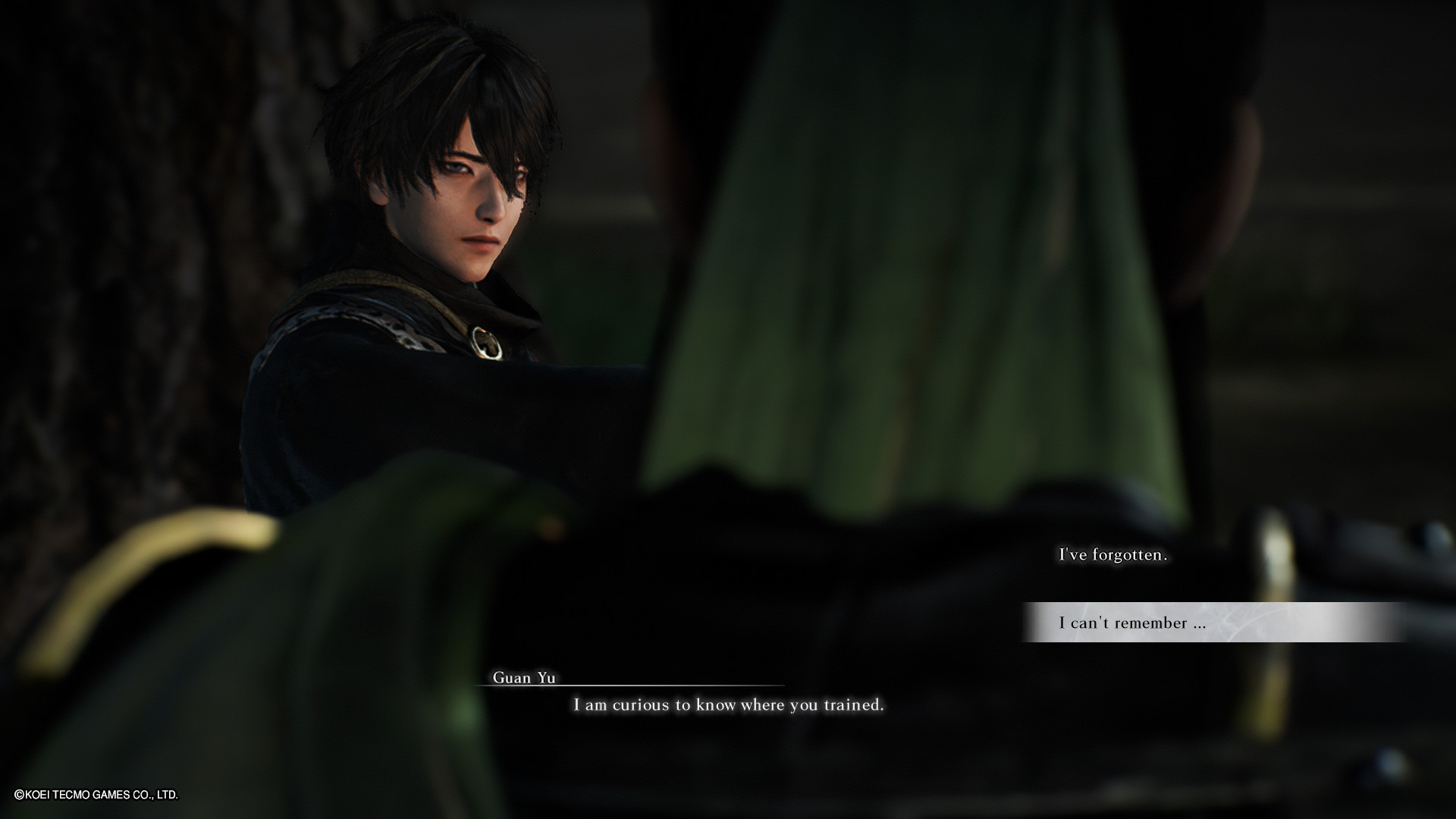
This is more streamlined and focused experience, doing away with Dynasty Warriors 9’s open world in favor of a focused story with a more limited number of playable characters. While the player primarily controls their original character, they can switch between different generals in some battles who have their own skillsets and abilities. The protagonist wanderer character can wield different classes of weapons with different move lists associated with them so he doesn’t ever feel stale to play as because his style of combat can be changed up regularly. The protagonist’s proficiency with different weapon types can be leveled up as well as his base stats from winning battles. Players can also earn gear that can be equipped to the hero to improve his stats.
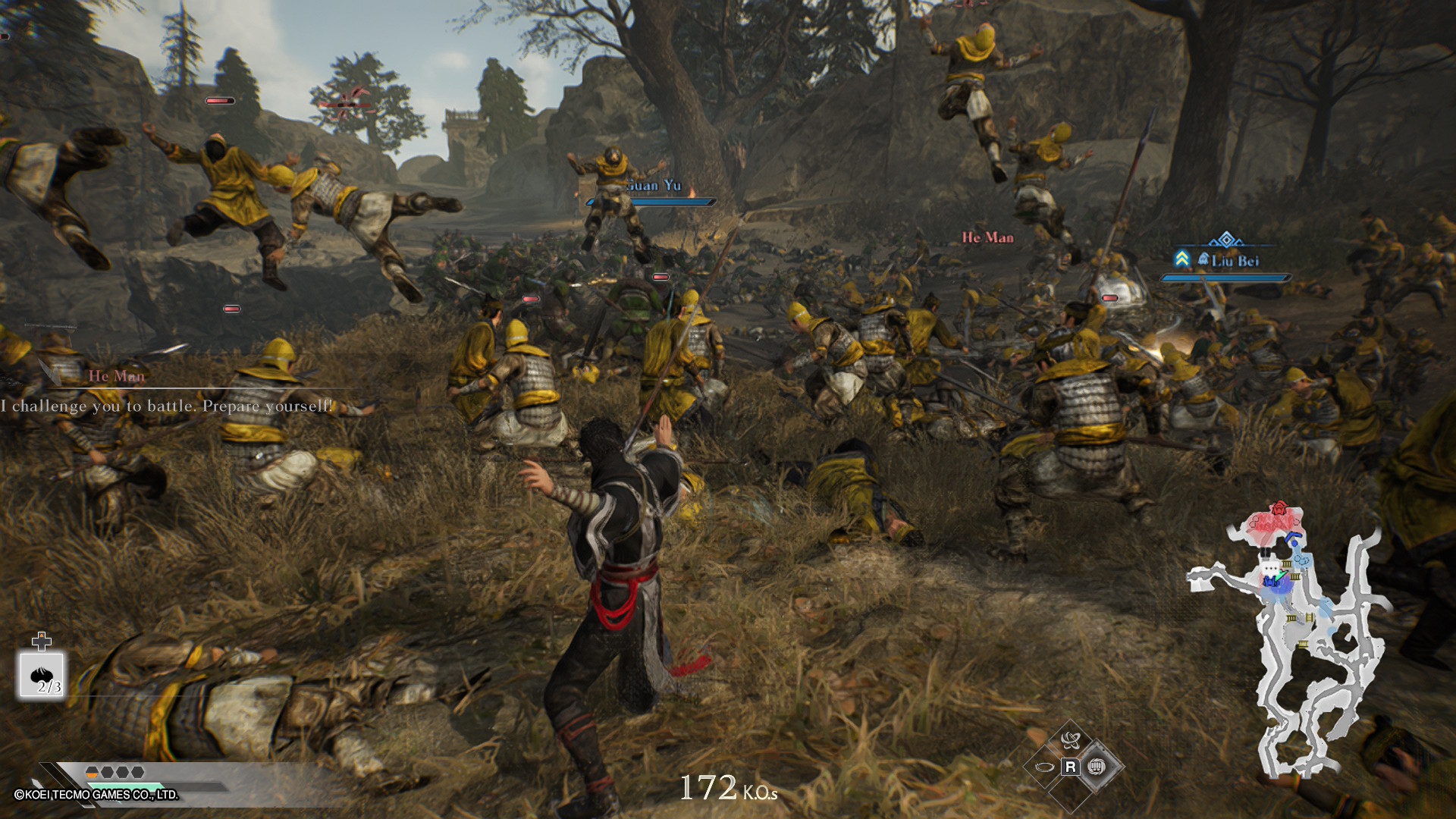
Like most other entries in the series, the primary gameplay loop takes place on a battlefield where the protagonist fights hordes of enemies, their foot soldiers, officers and generals to claim territories on the map for your aligned forces. Red blots on the mini-map mark enemy forces, and blue are allies. The objective is usually to take out their commanding officer and subdue their forces who are operating from different landmarks on the map. Sometimes your allies will fall under threat, and the player will have to rush to their aid before they are defeated in battle. Things can get quite difficult, and the difficulty does raise pretty consistently. The older games in the series were very punishing when you lost and you’d often have to start a battle fresh over if you lost or didn’t complete the goals you set out to achieve in a level. This time around, if the player is defeated, they can play a play-by-play mini-map recreation of their last run of the battle, which is really helpful when deciding where you could have made a different decision or gone to a different location to gain an advantage. Although I love playing these types of games, I’m not the best at them, so this feature was something I often took advantage of in my playthrough.
There are three different difficulty levels. My first run of the game was on the medium difficulty mode, but there is an easier “historian” mode for players who just want to experience the story without being challenged too much with the gameplay. There are different environmental objects that players can interact with, like ladders to go up and down and pots that can be broken for meat buns to restore health. Keeping your ally forces safe also often reaps benefits such as opening up shortcuts to get straight into deep enemy territory to move your comrades forward or distracting generals so it’s easier to hit big combos on them. As is series staple to dish out heavy damage, players combine light attacks and heavy attacks to lay major hurt. They also have access to stronger attacks that are triggered by filling up their Bravery meter, displayed above the health bar. Players can block, parry and dash to avoid and counter enemy attacks, and pressing the right stick in will lock on to a singular enemy if the player has a specific target they want to knock out. For stronger enemies, this is advisable as their attack ranges tend to be wider and their health bars are usually meatier and require more heavy damage combos.
There is a hub world that players explore which is a wide depiction of China where players go from kingdom to kingdom, interacting with characters, finding items and accessing fast travel checkpoints. The main character holes up in an inn where he reads letters that sometimes have a reward for him, or sometimes progresses the plot. This is also where players can customize their protagonist and save. . This title also boasts different language dubs, including English which I played in, and several subtitle language options as well. Dynasty Warriors Origins is a very polished video game, and this port on Nintendo Switch 2 runs impressively well. I have spent time playing docked and handheld and didn’t come across any major glitches, or slow down. I didn’t experience any frame drops, even with large swarms of enemies on screen.
My only gripes with the title come from the excessive loading times, which are understandable because there is a lot being loaded, but it does feel like it takes its time and the deeper I got into the plot, the more it began to irk me. There is also a bit of environmental pop in from background elements and sometimes enemies, but it was never enough that it felt like I was getting jumped or things were coming out of nowhere. The pop-in was still a bit away from me in any given map, but it’s something one can see in the distance. Some of the dub acting did feel like it was not matching up with the character model lip-sync sometimes, but this is a common situation when the games are animated with the Japanese voice cast performances in mind. I found the performances enjoyable albeit a bit hokey, felt very early 2000s anime at points.

Dynasty Warriors: Origins is a fun, focused gameplay experience that feels like it takes lessons from many different iterations of the franchise to create the best version of it yet. The difficulty levels may be high, but the rewarding gameplay and feeling of power is something that the series has always been good at, and that remains the case here. Some very minor technical issues aside, I had a blast with this title and I’m looking forward to playing even more.
Dynasty Warriors: Origins copy provided by the publisher for the purposes of this review.


