
The Legend of Heroes: Trails Beyond the Horizon review for Nintendo Switch 2
System: Switch 2 (reviewed) / Switch
Release date: January 15, 2026
Developer: Nihon Falcom
Publisher: NIS America
For more than two decades, The Legend of Heroes has been quietly building one of the most intricate and patient narratives in video game history. What began in 2004 with Trails in the Sky evolved into a sprawling, interconnected saga spanning multiple arcs, continents, and generations of characters, all unfolding within a single, meticulously constructed world. Unlike many long-running RPG franchises that reset with each entry, the Trails series treats its timeline as sacred: political shifts linger, personal choices echo forward, and side characters return years later shaped by events players once thought complete. By the time Trails Beyond the Horizon arrives, it does not stand alone so much as it stands atop the accumulated weight of twenty years of storytelling ambition. With that legacy in mind, Trails Beyond the Horizon arrives with immense expectations.
The Legend of Heroes: Trails Beyond the Horizon serves as a pivotal convergence point for the long-running Trails saga, pushing the series into a new phase while reckoning with the consequences of everything that came before it. Set in the aftermath of prior arcs, the game shifts its focus toward the political, technological, and existential tensions now facing Zemuria as long-suppressed truths begin to surface. Rather than acting as a simple continuation of one storyline, Beyond the Horizon weaves together multiple perspectives, reintroducing familiar faces alongside new protagonists whose goals and loyalties are not always aligned. The result is a narrative that feels both expansive and intimate—concerned as much with the fate of nations as with the personal costs of living in a world on the brink of irreversible change.
Trails Beyond the Horizon struggles most with its pacing, largely due to how unevenly its three-route structure is handled. Unlike Trails into Reverie, which maintained a disciplined rhythm by evenly rotating its routes, Beyond the Horizon seems to heavily favor Van’s route, often sidelining Rean and Kevin for long stretches. This imbalance creates a sense of narrative drag, especially when combined with a story that feels like extended setup for a climax that arrives far too late, and ends far too quickly. The game spends dozens of hours reiterating threats and positioning antagonists, only to compress its payoff into a finale that lacks the space to breathe. Had Falcom trimmed or consolidated several early chapters and redirected that time toward developing the ending – Sky FC being the obvious template – Beyond the Horizon would feel far more cohesive. As it stands, the Calvard arc mirrors Cold Steel’s bloating problem, but with a different structural flaw: its strongest payoff occurs at the arc’s outset, followed by layers of buildup that have yet to justify their length.
The route-specific pacing only sharpens these issues. Rean’s route is the most consistently engaging, benefiting from clear objectives, meaningful recruitment choices, and climactic boss encounters that give each chapter a sense of closure; his outsider perspective on Calvard’s mysteries provides momentum the rest of the game often lacks. Kevin’s route fares reasonably well thanks to his characterization and interactions with the picnic squad, but its investigative focus on Hamilton rarely culminates in satisfying confrontations, and its final chapter is surprisingly brief despite its evocative title. Van’s route, despite receiving the most screen time, is paradoxically the weakest paced – large portions feel redundant, with entire chapter segments existing solely to reintroduce Executors or Disciples who repeatedly posture, retreat, and advance the plot by inches. Van himself often lacks agency, pulled along by villains rather than driving events, making the time investment feel especially wasteful. While moments like Jorda’s arc in Anchorville and the excellent “Lingering Lie” chapter hint at what this route could have been, they are buried beneath excessive buildup that ultimately dilutes the game’s narrative impact.
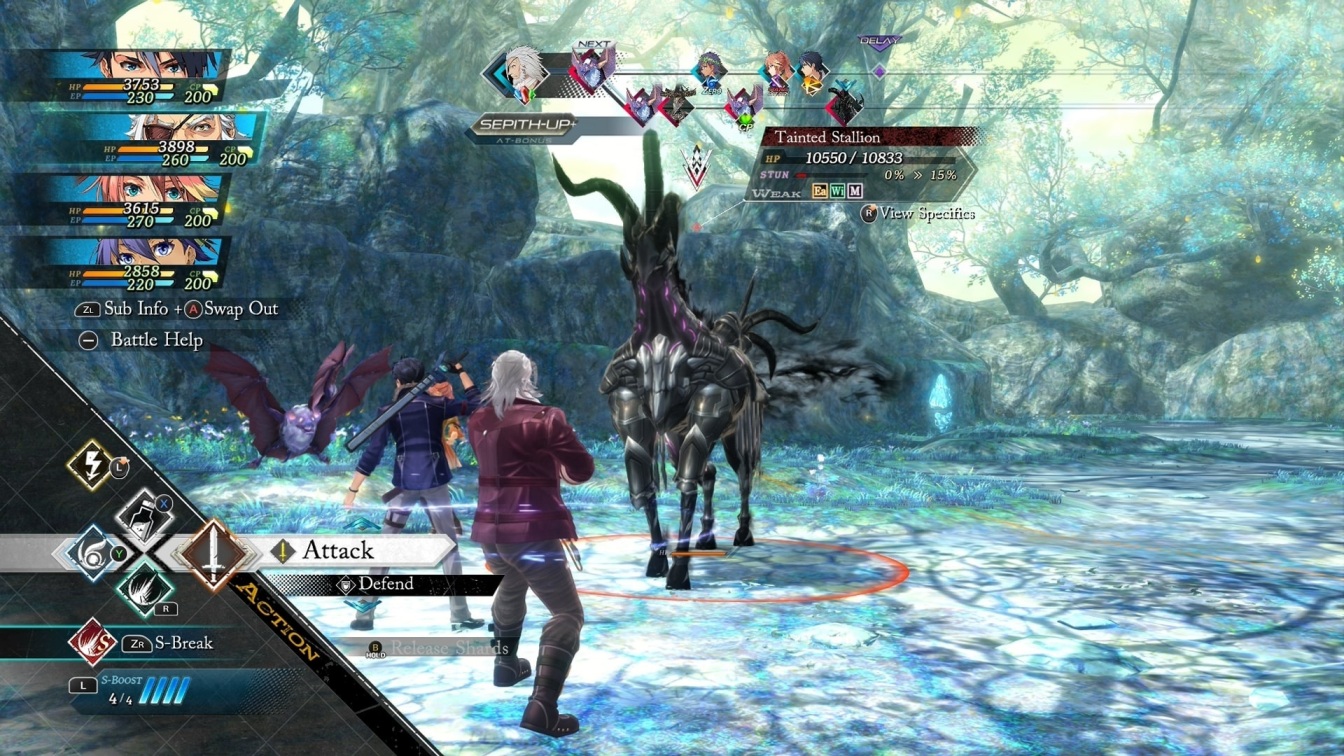
Combat in Trails Beyond the Horizon largely builds on the hybrid real-time/turn-based foundation established in recent entries, and while it doesn’t radically reinvent the system, it meaningfully refines it. The new BLTZ mechanic allows party members to chain additional hits onto attacks or amplify the damage of special moves, though in practice its impact feels fairly modest and rarely alters battle flow in a significant way. The real standout addition is the expanded Shard Command system, which functions similarly to Cold Steel’s Brave Orders but with greater flexibility. As shards accumulate during combat, they can be spent on powerful party-wide buffs, attacks, or utility effects, adding an extra layer of tactical decision-making. Commands like Lapis’s Noble Axe – capable of providing clutch, party-wide healing – often feel indispensable during tougher encounters, and the shift away from shards solely enhancing S-Crafts toward a broader set of strategic options gives battles more variety and reactive depth than in previous games.
The Grim Garten serves as the game’s large-scale optional dungeon, following in the footsteps of the Reverie Corridor and Märchen Garten, but players should be especially mindful of how it’s structured here. While it still functions as a sandbox that allows characters from different routes to fight together and experiment with unrestricted party compositions, it also plays a more direct role in the narrative. Once certain story thresholds are crossed, parts of the Grim Garten become inaccessible, and players cannot freely return to complete unfinished sections or view missed events. Several encounters and cutscenes within the dungeon are plot-relevant, making it important not to treat it as purely optional side content. While its inclusion does contribute to the game’s broader pacing issues, the Grim Garten remains a valuable space for character interactions, mechanical experimentation, and story context – provided players engage with it deliberately before moving too far ahead in the main story.
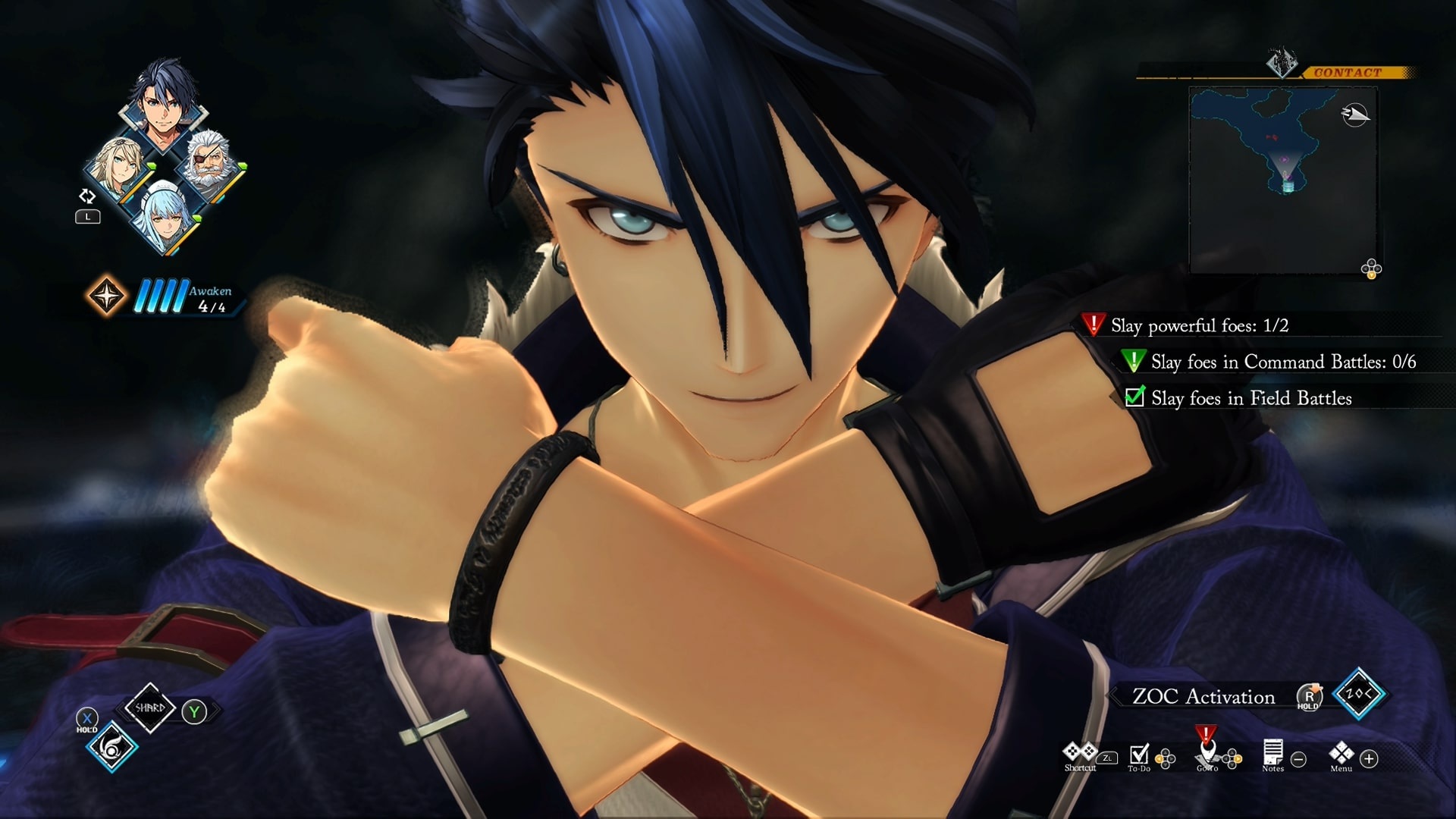
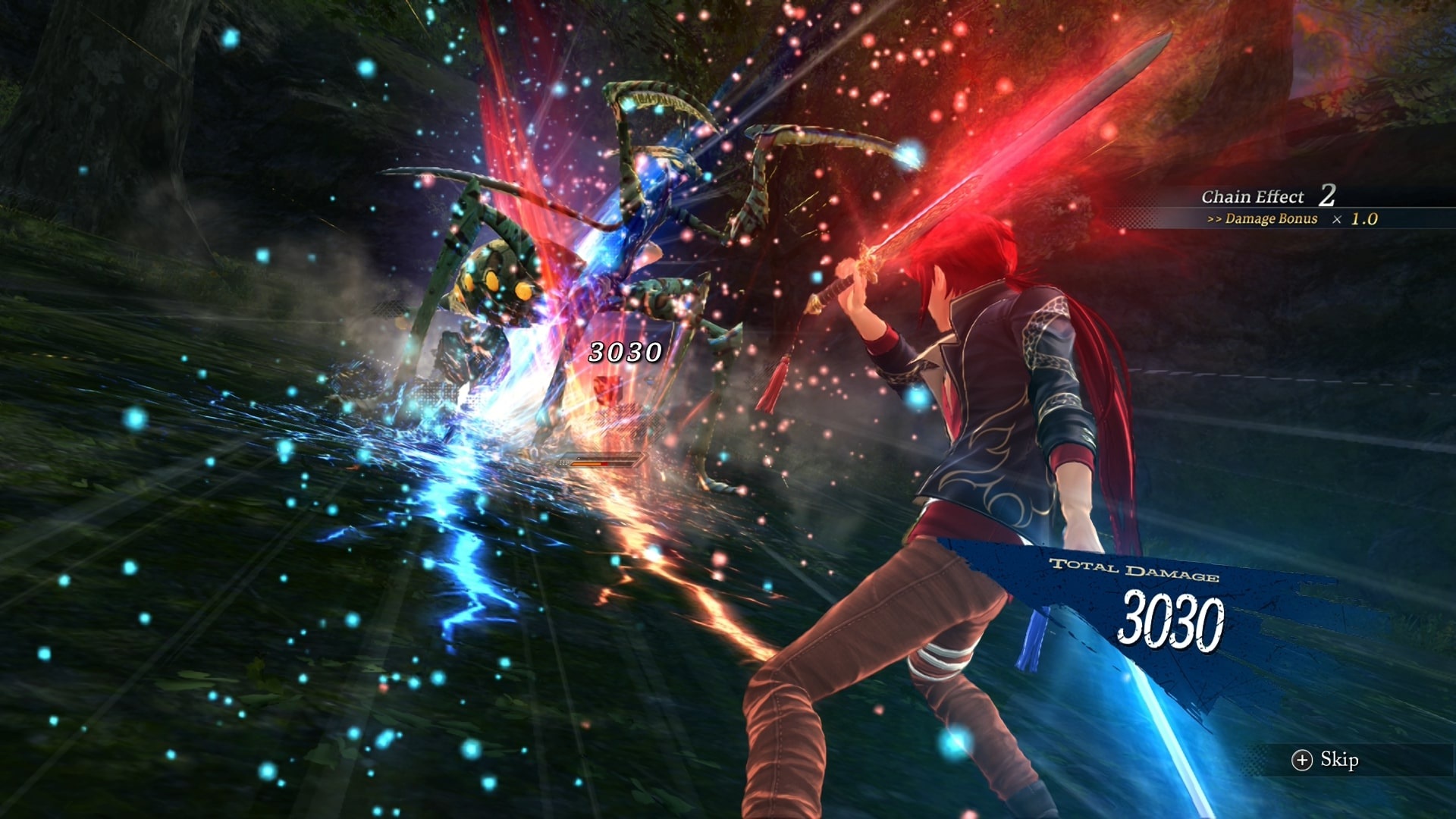
Trails Beyond the Horizon is, at its core, an exceptionally polished game on a mechanical and audiovisual level. It is easily one of the best Trails title to date in terms of visuals and combat feel, with dramatically improved craft animations and a battle system that finally addresses how trivialized difficulty had become in earlier entries. Boss fights are genuinely threatening, sometimes brutally so, and demand careful quartz planning and smart use of systems like Veil and Shard Skills rather than brute-force optimization. While the solution Falcom chose – especially inflating HP on erosion-focused bosses – has its own issues, the end result is a game where preparation and experimentation feel rewarding again. For the first time in a long while, managing quartz setups across the entire cast felt engaging rather than tedious, and certain encounters stand among the hardest and most memorable in the series.
The game’s multi-route structure is more divisive but still conceptually compelling. Seeing the full route select screen early on, backed by Crossing Wills, is one of the game’s most exciting moments, and the idea of giving each party distinct objectives works well on paper. Even when execution falters, the route system succeeds at creating anticipation – speculating about party compositions, guest characters, and intersecting storylines remains a genuine joy. Each route offers a different lens on Calvard, and while their quality varies dramatically, the structure itself reinforces the sense of a world too large and complex to be addressed by a single perspective. It’s a flawed system, but one that still produces some of the game’s most memorable emotional beats.
Where Beyond the Horizon truly shines is its music and final stretch. While some early tracks, like the standard battle theme, are among Falcom’s weakest, the overall soundtrack represents a major positive shift from past titles. Grim Garten’s battle theme is a standout track, and regional tracks like Longlai’s are hauntingly beautiful with the late-game boss and dungeon themes being nothing short of exceptional. The final hours deliver an almost uninterrupted run of stellar compositions that elevate the narrative payoff tremendously. That payoff itself is strong: the Grim Garten conclusion recontextualizes long-running characters like Novartis, Gramheart finally emerges as a fascinating and deeply human figure, and the lore revelations surrounding artifacts and timelines open exciting doors for the future of the series. Moments toward the ending hurrah reveal among the most powerful narrative experiences in Trails history even if they arrive frustratingly late. I am definitely avoiding mentions here, because I feel that any spoilers on this would be doing you all a great disservice.
Unfortunately, the game’s pacing undermines much of what the game does well. Despite being marketed as a payoff entry, Beyond the Horizon is largely a buildup game, stretching relatively thin plot progress across an enormous runtime. Entire chapters – particularly on Van’s route – sadly feel like filler, repeating the same structure of investigation, villain posturing, environmental damage, and retreat with minimal lasting consequence. The lack of a clear central antagonist for much of the game weakens narrative momentum, and elements like the Remnants and Grim Garten exacerbate the sense of narrative bloat. Compared to other exceptional entries like Azure or Reverie, where major developments occurred chapter by chapter, this game withholds its most meaningful revelations until the final hour. The result is a title that excels moment-to-moment but struggles as a standalone story — one that asks for immense patience, then delivers brilliantly, but far too briefly.
Despite its flaws, Trails Beyond the Horizon remains an important and often thrilling entry in Falcom’s long-running saga. Its mechanical refinements, striking presentation, and outstanding late-game music showcase a series still capable of growth and reinvention, even this deep into its lifespan. The ambition on display is undeniable: the scope of its ideas, the risks taken with its structure, and the groundwork laid for future entries all speak to a creative team thinking far beyond a single release. When the game allows its systems, characters, and themes to fully align, it reaches heights that few RPGs can match.
At the same time, Beyond the Horizon is a reminder that ambition without restraint can dilute impact. Its uneven pacing and prolonged buildup prevent it from standing alongside the strongest Trails entries as a complete, self-contained experience, even as it succeeds spectacularly in individual moments. For longtime fans, it is a rewarding but occasionally frustrating journey, but one that invites deep reflection, theory-crafting, and anticipation for what comes next. Trails Beyond the Horizon may not fully deliver on the payoff it promises, but it still earns its place as a compelling, high-quality chapter in one of gaming’s most meticulously constructed worlds.

As an avid fan of JRPGs, The Legend of Heroes: Trails Beyond the Horizon is still quite a hit – narrative pacing and filler-arcs aside, the setup we have here sparks a hunger for more once again – a move that we often see in Nihon Falcom’s recipe, and one that I am more than willing to keep falling victim to. While I do regret not spending as much time as I should have in the Grim Garten, the takeaway is “replay it and do better next time,” rather than any anger or angst toward the game itself.
The Legend of Heroes: Trails Beyond the Horizon copy provided by the publisher for the purpose of this review.


